posted March 29 2026
x-men re-examined: beyond good and evil
“Beyond Good and Evil” was supposed to be X-Men: The Animated Series’s grand finale, not just for the season, but for the whole show. It was to be a supersized story that culminated in permanent changes to the team roster. Regulars like Cyclops and Storm would depart, while new faces like Bishop, Archangel, and Psylocke would take up the cause of mutant-human peace. Then Fox decided to order an abbreviated fifth season, making such changes untenable. Per Eric Lewald, this story had to be completely reworked in about two days. It shows.
Should we grade this one on a curve? There are things to enjoy in these four episodes, particularly in Parts 1 and 2. But things rapidly fall apart after that, with tons of loose ends that never get properly resolved. Characters just sort of drop out of the story as it goes on. The core X-Men wind up strangely absent from their own finale, leaving the dumbest man in the franchise, Cable, to close things out with little more than a big gun.
Part 1: The End of Time
Season 4, Episode 18. Air date: November 4, 1995.
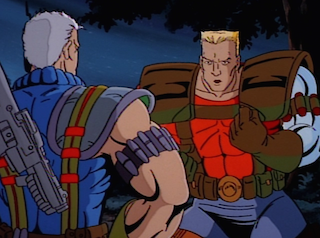 I have made my feelings about Cable abundantly clear throughout these reviews, so obviously I’m not thrilled to see we’re starting in 3999. Cable and—heavy sigh—Clan Chosen infiltrate Apocalypse’s pyramid. The animation is terrible. Just look at this screenshot of Cable’s son, Tyler, assuming you can make him out under his shoulder pads. The last time we saw Tyler he was a little kid, so either “3999 A.D.” is shorthand for an entire era, or they grow up very fast in the far future. The action is practically nonexistent. Cable unlocks Apocalypse’s defenses by waving his hand around and then asking his computer for the answer to a puzzle. He then attempts to kill Apocalypse with a gun. If this is your idea of a good time, you’re going to love the way this story ends.
The whole sequence is really just there to lay down the exposition. Apocalypse’s one actual weakness is that once every hundred years, he must return to his Lazarus Chamber to regenerate and sustain his near-immortality. Cable is predictably unsuccessful in trying to shoot Apocalypse, who snatches his time traveling computer in the midst of some delicious monologuing (“Evil? I am not malevolent. I simply am.”). Apocalypse muses that despite his obvious superiority, he’s been locked in a pointless struggle against lesser beings for millennia. Before Cable can grunt a reply, Apocalypse vanishes into the time stream.
Also appearing in the time stream: Bishop, who unluckily crosses paths with Apocalypse while trying to make the return trip from “One Man’s Worth” (points to the show for some ambitious continuity). Apocalypse’s intrusion into the time stream literally knocks Bishop out of the universe, landing him at the End of Time, a surreal space with a single inhabitant hanging out on a rainbow bridge (possibly the Bifrost). This weirdo, Bender, strongly evokes Robin Williams at the height of his cocaine era. Even at fourteen, I probably found Bender’s torrent of Looney Tunes gags and goofy non sequiturs grating. Bishop does his best to brush off Bender and begins walking toward the End of Time’s only point of interest: an Escher-inspired building that we’ll later learn is the Temporal Control Center. Bishop is going to be walking towards it for the entirety of this four-parter, if you can believe it.
Now fully halfway through the episode, we return to the present and finally see some X-Men. Cyclops and Jean are getting married, again, presumably having verified that their new priest is not a mentally traumatized shapeshifter. It’s a pretty lovely scene, actually. Beast quotes poetry, Xavier waxes philosophical about his first X-Men growing up, Rogue catches the bouquet (to her chagrin), and Wolverine looks utterly miserable. Hey, at least he bothered attending this time. I will also note that he’s wearing the same peach bowtie as everyone else, which implies that he’s in the wedding party. These are the kinds of details that escaped me in childhood but catch my eye in middle age.
Everything’s going great until Storm says as much out loud, practically summoning the Nasty Boys (Nasty Boys), plus the only cool Mutate, Vertigo. The Nasty Boys manage to knock Cyclops and Jean unconscious (one of her two natural states, along with Possessed by Cosmic Entity), and quickly toss her into a portal. While the X-Men are out searching for her, none other than Mister Sinister (last glimpsed in “Sanctuary”) appears at the X-Mansion to vamp. His goal is to abduct Xavier, and he nearly succeeds, but with Cyclops back in the fight by this point and a surprise appearance from Shard (chasing Bishop’s temporal anomaly), it’s all Sinister can do to flee through a portal as Rogue snatches Xavier. There’s practically an entire episode’s worth of character beats and fun action packed into these final ten minutes, and I have to give the show credit for some nimble storytelling here.
Sinister’s former henchmen are working for someone other than him. It’s all pretty fun, if nothing else. Seeing arch-nemesis Mister Sinister casually stride into the familiar home of the X-Mansion, especially after the coziness of a wedding, is pretty thrilling. The episode closes with Jean arriving at the End of Time, imprisoned in a glass tube, where Apocalypse is revealed as the mastermind of the whole scheme. This is played as a shock reveal, but given how the episode started, it doesn’t feel that way. The episode would probably have been better if it gave the entire run time to the wedding and melee with the Nasty Boys (feat. Vertigo), allowed the entrance of Apocalypse at the end be a genuine twist, and saved his motivations for a later flashback.
Stray observations:
-
Cable tells his son that “500 centuries” of research have led them to strike Apocalypse at this moment. He surely meant 50 centuries (5,000 years). Or maybe Cable is just really dumb, as the rest of this four-parter strongly indicates.
-
Apocalypse: “You DEFILE my saaaacred CHAAAAAMBER!???”
-
Rogue, catching the bouquet: “Whole lotta good it’s gonna do me.” Gambit is right there, Rogue!
-
As all hell breaks loose at the X-Mansion, Xavier tasks Jubilee with getting rid of the normie wedding guests. The next time we see her, she has done so. I really wish we’d seen how.
-
The Nasty Boys (Naaasty Boooooys) still aren’t the most interesting villain crew, but seeing them at odds with Arch-Delegator Mister Sinister was a fun twist. Unfortunately, they’ll skip most of the rest of the story, making only the most minor contributions to the fights in Part 4.
Part 2: Promise of Apocalypse
Season 4, Episode 19. Air date: November 11, 1995.
Part 2 is this story’s finest half hour, absolutely packed with ambitious action and a ton of guest characters. Even keeping my summary to the bare essentials, it’s a lot, so apologies in advance.
This twenty minutes has a little something for everyone, even the freaks who like the Shi’ar. Empress Lilandra’s troublesome sister, Deathbird, is attempting a violent coup. She gets worrisomely close to offing Lilandra, before Gladiator bursts through the floor to stop her. It’s at this point that Deathbird’s ace in the hole, Apocalypse, emerges from a portal and abducts not Lilandra, but her court psychic, Oracle. John Colicos makes a meal out of double-crossing Deathbird before departing. Having Apocalypse visit the Shi’ar was a smart way to raise the stakes, but just as with the Nasty Boys, we won’t be seeing them again.
Back at the End of Time, Jean coaxes a little more exposition out of Apocalypse. We learn that since time doesn’t pass here, he’s been able to spend the equivalent of a thousand years studying the Temporal Control Center. Sinister and Deathbird (and later, Magneto, Mystique, and Sabretooth) are all working for Apocalypse because he’s promised them whatever they most want, though how he plans to deliver, if at all, remains a mystery.
Back on Earth and with the benefit of a tip from Lilandra, Xavier reasons that whatever Apocalypse’s goal is, he’s abducting psychics to accomplish it. For those of us in the audience who like it when characters have thoughts and opinions, the episode makes time for a sharp little debate about what to do next. Cyclops wants to surveil other psychic mutants in case the bad guys show up. Storm is firmly against the idea of using people as bait (“You cannot endanger innocent people just to save Jean.”), and Gambit, as usual, has a more chaotic take. “If they be psychic, they already know, right?” Xavier gets the final word, agreeing with Cyclops and setting the episode’s wild second half in motion.
I was going to tee up this part with some background on Psylocke, but good lord, look at her Marvel Fandom entry. More twists and turns in that character history than the Temporal Control Center. Suffice to say that Elizabeth “Betsy” Braddock started out in the pages of Captain Britain, Marvel’s 1970s attempt to break into the UK market. By 1995, she had become Psylocke, a hot telepathic ninja who wields stylish purple “psi-daggers”. Now That’s What I Call ’90s!
Psylocke is an elite thief, and we get our first glimpse of her as she’s sneaking into Worthington Castle. Archangel, who’s looking a lot more sane than the last time we saw him, wastes little time confronting her. The quick fight culminates with Psylocke nonsensically jumping off a cliff, or so it seemed. It’s one of the last clever things we’ll see anyone do in this entire story. Archangel, who is clearly into Psylocke, rescues her, only for her to literally stab him in the back and knock him unconscious. He wakes up just as Psylocke is driving away with his stuff, so he decides to tail her back to her London warehouse.
Wolverine and Shard, following Xavier’s plan, have been on a stakeout near the warehouse just in case Psylocke showed up. Psylocke and Archangel start going at it (fighting! I mean fighting!), with Psylocke accusing Archangel of being a wealthy assimilationist and Archangel accusing her of being a common thief. Before they can finish the argument, Sabretooth rips through the warehouse doors, followed by Mystique, who is followed by Wolverine, Shard, and—surprise!—Magneto. So there are seven powerful mutants duking it out over the course of a few minutes. The whole sequence is maybe a little too cute and quippy, but Jennifer Dale’s sardonic performance as Mystique stands out as especially fun.
Magneto brings the fight to a decisive end. He pins Wolverine to a conveniently placed battleship (the warehouse is next to a harbor). He then drops the entire ship, Wolverine still attached, on Psylocke’s warehouse, just to make a point, before carrying her into a portal. Back in “Family Ties”, when the High Evolutionary said that Magneto’s genes were the key to overwhelming mutant power, he knew what he was talking about.
Storm and Gambit rush over from their own stakeout to do cleanup, which as we’ll see in the final scene, allowed Sinister to abduct another unnamed (and apparently not very important) telepath. Lastly (and leastly) we revisit 3999 A.D., where Cable and Tyler are manfully climbing a cliff, as Cable explains that he’s going to steal the government’s last remaining time machine.
Oh, and we also get a quick shot of Bishop walking toward the Temporal Control Center. That’s all for him this episode.
Stray observations:
-
Apocalypse had, by his own reckoning, a millennium to hatch this scheme. Wouldn’t it be much harder to interfere with his plan if he abducted psychics from across the centuries, instead of sticking to 1995? Cartoons!
-
Archangel, regaining consciousness: “That’s the last time I save a falling ninja.”
-
Shard notes that Archangel is “destined to join the X-Men,” an obvious leftover from the version of this story that was going to permanently shuffle the team.
-
When I say this episode is a little too quippy for its own good, I mean lines like Gambit’s, “All tied up and nowhere to go?” as he frees Wolverine from the side of the ship.
-
On the toilet: technically, all of the core X-Men appear, but Rogue and Jubilee are inexplicably relegated to blink-and-you’ll-miss-them background appearances, essentially dropping out of the story after Part 1.
Part 3: The Lazarus Chamber
Season 4, Episode 20. Air date: November 18, 1995.
Part 3 is where “Beyond Good and Evil” falls apart. We pick up with Cable and Tyler in 3999 A.D., unfortunately. To stop Apocalypse, Cable wants to destroy his Lazarus Chamber at its origin point in 1200 B.C. To do that, he has to gain access to the world’s last remaining time machine, and to do that, he needs to infiltrate a heavily guarded facility. Whose facility? Cable’s comments in the last episode suggest it belongs to the government, but if that’s true, what’s the deal with Apocalypse ruling 3999? It’s all terribly vague and impossible to care about. Cable grunts his way through a series of explosions, interchangeable robot soldiers, and lots—and I mean lots—of gunfire. More guns than this show has ever seen in a single episode, I think. A really upsetting amount of guns. Even this sequence’s best attempt to gin up the stakes, by putting Tyler in harm’s away (again, from a random robot, for no clear reason) involves Tyler just trading gunfire with the thing for what feels like forty-five minutes. This feels like a completely different show, and a bad one at that.
Anyway, Cable takes control of the hybrid time machine / spaceship known as Graymalkin, and nearly runs Bishop over while passing through the Axis of Time (Bishop spends this episode continuing to walk forward, FYI). Apocalypse, from his vantage point in the Temporal Control Center, cackles malevolently and forces Cable to detour to 1995. I’ll give the episode this much: that’s a nice bit of foreshadowing that Apocalypse has things well in hand and Cable’s plan isn’t going to work.
Cable lands at the X-Mansion right around the time that Wolverine beats the crap out of Sabretooth to try to learn more about Apocalypse’s scheme. Wolverine comes away with almost no new information, so Xavier decides to violate his own code of ethics and read Sabretooth’s mind against his will. Looking like heroes here, guys. All Xavier learns is that Apocalypse wants to use his abducted psychics to “master time”, somehow.
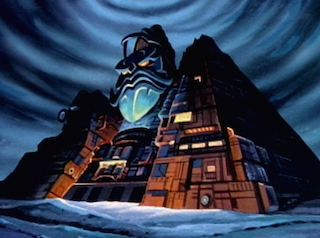 The X-Men decide that their best shot is to follow Cable’s lead and travel with him to 1200 B.C. to destroy the Lazarus Chamber. Not that Cable would be willing to do anything else, of course. He repeatedly tells the X-Men that their problems are boring and don’t matter to him, never mind that the X-Men’s current cosmic-level problem is a direct consequence of Apocalypse stealing a time machine from Cable. And let’s remember, dear reader, that the currently imprisoned Jean Grey is Cable’s mother, without whom he cannot exist. So anyway, welcome to Apocalypse’s insane looking pyramid, architectural design by Dr. Wily.
Cable’s aggressive stupidity is so obvious by now that I think even the writers had to start commenting on it. Cyclops asks Xavier why Apocalypse might be abducting psychics:
Cable: Who cares? He’s pure evil and that’s why he’s GOTTA GO.
Beast: If Apocalypse is indeed the personification of evil, it may be impossible to destroy him.
Cable: WHY???
Beast: The conflict between good and evil is part of the fabric of existence. Perhaps the world cannot exist without evil. If Apocalypse is destroyed, evil may only take another form.
Cable: I’ll worry about that later.
It’s like watching Voltaire attempt to educate a clenched fist. My heart breaks for Hank McCoy. And later, when Cable and the others have gotten inside the pyramid:
Cable insists that he already knows every trap in the pyramid, then nearly falls into a spiked pit.
Cable: Thanks, I don’t know how I missed that one before.
Beast: Apparently Apocalypse will make a few alterations in the next five thousand years.
I’ll take this opportunity to point out that if Cable had been allowed to do what he’d originally wanted—travel to 1200 B.C. alone to destroy the pyramid—he’d have fallen into that trap and died right there. God, what a moron.
Anyway, by this point the good guys are fighting their way toward the Lazarus Chamber, having been met by Apocalypse’s Egyptian-era Four Horsemen. They look cooler than their modern day counterparts, I’ll give them that much. Other than that, the action is pretty basic. Cable does actually manage to do one smart thing, using his knowledge of the pyramid’s booby traps to take out one of the Horsemen. Another one of them lands on Cable with an entire horse, and while this doesn’t do permanent damage, it ensures that he won’t be able to proceed into the Lazarus Chamber with the rest of the team.
The good guys finally arrive at the Lazarus Chamber, only to realize too late that they’ve fallen into a trap. “Apocalypse” is revealed as a disguised Mystique, and the real Apocalypse electrifies the entire chamber from the comfort of the Temporal Control Center (somehow). Apocalypse claims his ultimate prize, Charles Xavier, while Cable stumbles into the Chamber to find everyone else unconscious.
Stray observations:
-
Cable says “nail” a lot. I realize it’s an S&P approved substitute for “kill”, but like everything with Cable, it just feels so edgelordy and lame.
-
On the toilet: Rogue and Jubilee, once again.
Part 4: End of the Beginning
Season 4, Episode 21. Air date: November 25, 1995.
In The Matrix, Morpheus explains that the entire human race is being held prisoner in a virtual reality simulation so that their machine overlords can use their bioelectricity and body heat as fuel. “Combined with a form of fusion, the machines had found all the energy they would ever need,” he says. An entire generation of nerds have pushed up their glasses to point out that this makes no sense, that a human body would make for a terribly inefficient power source. But these nerds are missing something. The phrase combined with a form of fusion is all the explanation the Wachowskis needed. It’s a perfect verbal sleight of hand that makes the premise feel plausible. It puts enough science in this fiction to keep our disbelief suspended. That, I think, is what differentiates sci-fi from fantasy. Sci-fi is rooted in the knowable (or at least feels that way), while fantasy is rooted in mystery, where power is ineffable and things Just Are. Neo can break the laws of physics and come back from the dead because he has learned to perceive the code underneath the Matrix. Gandalf can break the laws of physics and come back from the dead because he is Gandalf.1
I say all this because Apocalypse’s master plan doesn’t read as sci-fi to me. Sure, the wider Marvel universe has its fair share of magic. In the comics, more than one X-Man has been to Hell, which is a real place. But the show has steered clear of the magical side of Marvel, remaining firmly in sci-fi. Apocalypse’s plan doesn’t feel as if it’s grounded in the same world as mutants and time traveling cyborgs. Instead, it feels like a magic ritual. There’s even an orb.
Apocalypse’s version of “combined with a form of fusion” is this: “Time is motion, and motion and thought are a unity. Two aspects of a single power that is beyond comprehension to all but myself. That is why certain psychics can see into the future. The mind can transcend time.” By gathering together all these psychics at the Axis and then sacrificing them, Apocalypse will destroy time itself and remake the universe in his own image.
I like the idea that psychics derive their powers from a special relationship with time. The mind can transcend time even has a grain of truth to it. After all, memory is the mind traveling to the past, and planning is the mind traveling to the future, so to speak. But the show hasn’t really done anything with the idea other than say it out loud, making “therefore Apocalypse can use psychics to destroy the universe” a hard pill to swallow.
But alright, this is a make-believe cartoon for little kids. Maybe I’m asking too much, even though we’ve seen the show do much better. Even giving the story’s premise the benefit of the doubt, what Part 4 does with the core cast is just unforgivable. In the immediate aftermath of Part 3, Cable blows up Apocalypse’s pyramid in 1200 B.C. and we see five X-Men (Cyclops, Gambit, Storm, Beast, and Archangel) board the Graymalkin with him. Yet when Cable eventually arrives at the End of Time, somehow it’s just him. Everyone else vanishes from the story until the epilogue. Wolverine is also there, because it’s very important that Wolverine be present for all big stories.2
Part 4’s action revolves around two things, the first of which is the collapse of Apocalypse’s tenuous alliance with his fellow villains. Upon learning the true intent of Apocalypse’s plan, Magneto is disgusted to be in league with someone who “would destroy the innocent along with the guilty.” It’s a nice character note and it kicks off the betrayals and counter-betrayals that will fill the back half of this episode. Magneto and Mystique do their best to fight off Apocalypse and the Horsemen. While Magneto and Mystique have famously great chemistry in the movies and comics, they’ve never even been in the same room on this show, and yet it still feels really cool to see them fight together. What’s less cool is the mounting obviousness of the second thing that powers this story: guns. Mystique somehow holds off the Four Horsemen with nothing but a laser pistol while Magneto frees Wolverine.
Meanwhile, Bishop ambles ever closer to the Temporal Control Center, once again enduring Bender. I wish Bender’s incessant craziness had a point, that maybe his constant stream of nonsense would turn out to be clues that Bishop eventually uses to gain the upper hand and save the day. But no, Bishop doesn’t learn anything useful from these interactions. He just notices the newly added ring of hovering psychics around the Temporal Control Center and decides to shoot one out of the sky. It happens to be Psylocke, and she tells him to shoot down as many as he can, so he does.
Back at the Temporal Control Center, Wolverine and Mister Sinister engage in a minor tussle that shatters Apocalypse’s magic orb, reversing his attempt to destroy time (cue footage of the Shi’ar, random New Yorkers, and a few leftover X-Men fading out of or into existence). Sinister decides to cut his losses, and he and the Nasty Boys (Nasty Boys) head for the nearest portal. A few seconds later, Cable shoots Apocalypse with a big rifle, which somehow causes the Temporal Control Center to shatter into little floating pieces. There’s some slightly fun back and forth as Wolverine and Magneto save each others’ lives, only for Apocalypse to make one last literal power grab via another magic orb. By this point, Bishop has finally made his way to the center of the action and—say it with me—shoots the orb. Apocalypse brags that he is immortal and can never truly be stopped. That’s when Professor Xavier, leading the newly freed psychics, declares that their combined power is enough to pull Apocalypse out of the Axis and put him back in normal time, where he’ll cease to exist (Cable destroyed his regeneration chamber, remember?).
Apocalypse had a thousand years to plan this. Bishop and Cable foiled it with a couple of rifles. Everyone departs for the regular universe, and Bender turns to the camera to reveal that he’s actually Immortus, longtime Marvel villain and Kang the Conquerer variant. It’s a twist out of nowhere and it will never be revisited. Maybe this was all Immortus’s convoluted way of removing one of the only true threats to his own power? Who can say? Certainly not the writers.
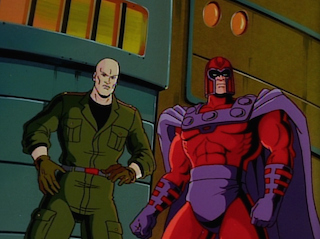 In the epilogue scene, noted paraplegic Charles Xavier is depicted standing next to Magneto. This isn’t a blink-and-you’ll-miss it animation error, either. He even gets a few lines while fully upright!
Beast asks Cable if, having destroyed what he considers the incarnation of evil, he thinks the world has been changed. He replies, “I really don’t care. I just wanna go home.” I’m sure this sounded cool to an exhausted writers’ room. Archangel says to Psylocke, “I wish I’d been there to help,” and you know, me too, buddy. Why weren’t you? Why wasn’t anyone?
A story this big with an ending this bad triggers in me an overwhelming urge to suggest some rewrites. As this review is already way too long, I’ll keep it to three items:
-
For the love of God, get rid of Bender. He’s annoying and completely pointless. Everything Bishop learns during his slow, slow walk to the Temporal Control Center comes from various hanging time portals, not this Yakko Warner ripoff.
-
Psychics having a special relationship with time is a cool idea, but the story doesn’t do anything with it. What if instead, characters occasionally received mysterious messages from out of nowhere, cryptic hints that help push the story along or pay off in weird ways. Imagine Wolverine seeing an apparition of Jean before he interrogates Sabretooth, or Archangel dreaming of Psylocke before they meet, or Xavier getting a strange message from himself, with the final reveal that it’s all been coming from the trapped psychics at the End of Time. The psychics get to do more than just lay around, and Apocalypse’s monologue about their true power gets some weight behind it.
-
Cable is the son of Jean Grey and a powerful telepath in his own right. The TV show has never once shown him using his mutant powers. It’s all guns all day, forever. It would make for a fun twist if the crown jewel of Apocalypse’s collection of psychics wasn’t Xavier, but Cable. Over the course of the story, Cable would move from protagonist to damsel to, perhaps, a more interesting hero in the final minutes. It might also present an opportunity for Jean to do anything in the finale.
Stray observations:
-
The animation is all over the place in this episode. Bishop’s rifle doubles or halves in size depending on the scene.
-
Archangel, theatrically berating Cable in the aftermath of Part 3: “He knew! Apocalypse knew your stupid plan before we made our first move!” I think Archangel is this story’s MVP, honestly.
-
Apocalypse: “You have traveled over 50 centuries of time to stop me. When will you learn it cannot be done?” See? Somebody knows how to do math.
-
On the toilet: technically no one. Everyone appears at least briefly in this story, even if they’re just wordlessly vanishing in and out of existence. But they might as well be in the bathroom.
-
Yes, my nerds, I understand that Gandalf merely has the form of a wizened old man, that he is actually one of the Maiar. He is a literal angel sent from the Undying Lands to walk Middle Earth and guide its inhabitants toward their best selves. But that doesn’t really explain anything, does it? Gandalf just is this supernatural being, and his powers, mysterious and unknowable, simply are. ↩
-
Apocalypse, who has tied up Wolverine, comments that he’d regret “jumping into the portal”, even though that is absolutely not what we saw at the end of Part 3. ↩