posted January 11 2026
x-men re-examined: proteus
Season 4, Episodes 11 and 12. Air dates: September 30 and October 7, 1995.
Mutants are metaphors for the other, the outcast, the strange. Of course, X-Men’s stories tend to follow the adventures of mutants who are conventionally attractive and have an array of cool, useful powers, somewhat diminishing the point. Occasionally, the franchise tries to tell stories about mutants who just want to live normal lives, or of mutants who simply can’t live in “normal” society at all, like the Morlocks. Even more rarely, we’re told a story of a mutant who is too dangerous to live, period. Ultimate X-Men #41, for example, is an all-time great issue on the topic (CW: very tragic).
A similar idea plays out in Uncanny X-Men #125-128, in which the character of Mutant X / Proteus / Kevin MacTaggert debuts and dies. The secret child of Moira (Xavier’s once-fiancé and longtime ally) and Joe (evil politician) MacTaggert, Kevin has lived his entire life in a containment cell. His powers are both terrible and overwhelming: he lacks a physical body but can possess almost anyone, rapidly burning out their physical forms in the process. On top of that, he has practically unlimited reality-warping powers that make him an extreme threat to anyone who crosses his path. In his debut story, he escapes containment, tracks down his absentee father, murders him (along with a trail of innocent people), and is finally killed when he tries to possess Colossus (Proteus’s one vulnerability is metal). It’s a sad and violent story about the terrible sacrifices that are necessary to eliminate a truly uncontrollable power. Perhaps not coincidentally, these issues immediately precede the Dark Phoenix Saga.
Color me surprised that X-Men: The Animated Series tried to adapt this one. To make it work, they had to soften all of the violence and radically change the ending. Kevin can still possess anyone but doesn’t kill his victims in the process. His vulnerability to metal never comes up, thus eliding the need for anyone to try to shoot him with bullets, as his own mother does in the comics. He still tracks down his father and confronts him, but instead of ending in murder, it ends with a hasty reconciliation and a decidedly unearned happy ending. After acting like an utter villain for the entire two-parter, Joe MacTaggert has a literal last-minute change of heart and carries Kevin away in his arms,1 an ending that even Eric Lewald (the show’s head writer) called “a bit much”.
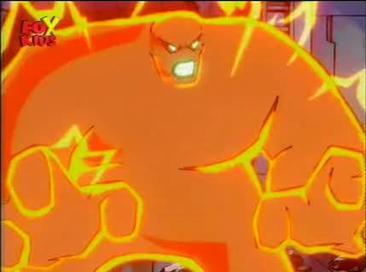 The main story is pretty straightforward and just kind of blends together across both episodes, hence why I’m not bothering to review each part separately. Kevin escapes containment on Muir Island and gradually makes his way to Edinburgh to confront his father, a prominent politician running on a family-first platform. Kevin is limitlessly powerful, but also so sheltered that he finds everything about the outside world overwhelming. This could have been interesting, but Kevin is so singularly focused on finding his father that everything becomes, “Where’s my dad?” Proteus’s extremely goofy character design, somewhere between the Kool-Aid Man and a living Dorito, doesn’t help matters. I will, however, give credit where it’s due: the animation of Proteus’s reality-warping abilities is really well done, especially with what happens to Wolverine.
Oh yeah, consistent with the original story, Proteus uses his powers to melt Wolverine, at least temporarily (his powers only stick while he’s in the immediate vicinity). The animation of Wolverine’s claws turning into little serpents, then the man himself splitting in half and melting into a puddle is, needless to say, pretty wild. Wolverine emerges from this experience rocking back and forth and crying, and he remains pretty traumatized throughout the story. Wolverine has appeared in almost every episode of this show, and we’ve never seen him like this. He’s so scared of Proteus that he runs away from two subsequent fights, but steels himself long enough to help the good guys at least a little. The show doesn’t really do the work to make this an “overcoming your fears” story, but still, one cannot simply remove Wolverine from the fight completely (except for “A Deal with the Devil”).
This story spends a lot of time on Professor Xavier, as many stories have this season. We get an extensive montage/flashback of his early days with Moira, her breaking off their engagement while Xavier was deployed in the army (probably the Korean War, also presumably where he lost the use of his legs), her going on to marry and then divorce Joe MacTaggert, and finally hooking up with Banshee (you know, Saturday morning stuff). The flashback even repeats Xavier’s meeting Amelia Voght in rehab, founding the X-Men, Amelia leaving him, etc. Throughout these episodes, Xavier tells us (and shows us) how deeply he still cares for Moira, and for her wayward son, no matter how dangerous he may be. He’s got more chemistry with Moira here than he ever had with Lilandra the Space Empress.
It looks like Proteus is going to kill his father just as he did in the comics, until Xavier finally manages a psychic breakthrough with the rampaging teen. It really feels like the story is setting up Xavier to become Proteus’s surrogate father, but things take a sharp turn at the very end. Joe, who’s been alternately completely callous toward his abandoned son or straight-up terrified of him, suddenly feels his heart grow two sizes and carries the kid away. It’s a completely unearned heel-face turn that instantly abandons everything this story has been trying to say about what it means to be a parent.
Now That’s What I Call ’90s: Moira shows Xavier some campaign footage of Joe MacTaggert that she’s recorded on VHS.
Stray observations:
-
In his campaign speech, Joe MacTaggert says, “What Scotland has lost is family values. As Secretary of State, I will bring Scotland back to the family values that made it great.” The more things change, right?
-
Wolverine goes through several wardrobe changes in this story: his usual costume, his typical flannel casual wear, and inexplicably, a cowboy getup out of Westworld.
-
Rogue has a minor role in this story but Lenore Zann makes it count. “Guess he [Joe] likes children, if they ain’t his. I’ve seen that happen before.” The way Zann delivers this line is simply a cut above everyone else, and it leads into a not-strictly-needed brief flashback about her own abusive father. The episode is trying, at least.
-
As I said, a lot of the animation of Proteus’s reality-warping powers is pretty cool, but the fight scenes bite off more than they can chew. The fights are confusingly staged, and in several places the animation just doesn’t deliver.
-
At one point in Part 2, Beast is quoting a book, the cover of which has been blurred out for broadcast. Reddit confirms that this was originally The Making of the President, a book about JFK. It’s unclear why Disney censored it. Either they didn’t want to risk having to clear the rights, or the loosely drawn cover—a vague sketch of an eagle rendered in shades of brown—accidentally came out a little too Third Reich.
-
On the toilet: everyone except Xavier, Rogue, Wolverine, and Beast.
-
In the comics, Proteus lacks a physical body, hence the urge to possess people even if it kills them. On the show, Kevin has a body of his own and can rather conveniently switch between that and his energy form at will. ↩